
Products
Product Detail
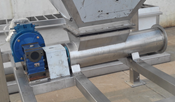
*SS316L/304
A Screw Conveyor (also called an auger conveyor) is a simple, robust mechanical device designed for the horizontal, inclined, or vertical transport of bulk solid materials—including powders, granules, pellets, and small lumps. It operates using a rotating helical screw (auger) housed within a fixed trough or pipe, which moves material forward by leveraging the screw’s rotational force to push particles along the conveyor length. Widely used in agriculture, food processing, mining, construction, and chemical industries, screw conveyors are valued for their compact design, low maintenance, and ability to handle a broad range of materials.
Core Working Principle & Operational Workflow
The operation of a screw conveyor relies on the interaction between the rotating auger and the material being transported, with a straightforward, continuous workflow:
- Material FeedingBulk material is loaded into the inlet end of the conveyor’s trough or pipe—either manually, via a hopper, or from an upstream processing machine (e.g., mixer, filler, bucket elevator). The inlet is designed to prevent material bridging or clogging, with optional vibratory feeders for non-free-flowing materials like wet sand or sticky powder.
- Auger Rotation & Material TransportA motor-driven gearbox rotates the helical auger at a controlled speed (typically 20–100 rpm, depending on material type and throughput). As the auger spins, its helical flights (blades) push the material along the inner surface of the trough/pipe toward the discharge end. The transport mechanism varies slightly by conveyor orientation:
- Horizontal screw conveyors: Material moves via the forward thrust of the auger flights, with minimal lifting required—ideal for short to medium-distance transfer (up to 30 meters).
- Inclined screw conveyors: Material is pushed upward while moving horizontally; steeper inclines require larger flight pitch or specialized flight designs to prevent material backsliding.
- Vertical screw conveyors: Auger flights lift material upward against gravity, with a compact footprint suited for tight spaces—typically used for short vertical lifts (up to 8 meters).
- Material DischargeWhen the material reaches the discharge end of the conveyor, it exits through a chute or opening into a storage bin, packaging machine, or downstream process. Some models feature adjustable discharge gates to control the flow rate of material, while others have multiple discharge points for flexible distribution.
- Cleaning & Maintenance CycleAfter operation, the conveyor can be cleaned by reversing the auger rotation to remove residual material, or by opening access doors along the trough for manual cleaning—critical for preventing cross-contamination in food or pharmaceutical applications.
Key Components
- Auger (Screw Flight): The core moving part, typically made of carbon steel (for abrasive materials), stainless steel (for food-grade or corrosive materials), or plastic (for lightweight, non-abrasive materials). Flight designs include full flight (for high throughput), cut flight (for sticky materials to reduce clogging), and ribbon flight (for fine powders to minimize dust).
- Trough/Pipe: A stationary enclosure that houses the auger and contains the material. Troughs are open-top (for easy loading/cleaning) or closed-top (for dust control), while pipes are fully enclosed for vertical transport or hazardous material handling.
- Drive System: Comprises an electric motor, gearbox, and coupling to rotate the auger at a controlled speed. Variable-frequency drives (VFDs) are optional to adjust throughput based on production needs.
- Bearings & Seals: Support the auger’s rotation and prevent material leakage or dust emission. End bearings are located at the inlet/discharge ends, while intermediate bearings may be added for long horizontal conveyors to reduce auger deflection.
- Inlet/Discharge Hoppers: Guide material into and out of the conveyor, with designs optimized for different material flow properties (e.g., wide-mouth hoppers for lumpy materials, narrow hoppers for fine powders).
Key Features & Advantages
- Compact & Space-Saving DesignScrew conveyors have a small horizontal footprint compared to belt conveyors, making them ideal for installation in tight factory spaces or between existing equipment. Vertical models take up minimal floor space for vertical material transfer.
- Versatile Material CompatibilityThey can handle a wide range of bulk materials, including free-flowing granules (grains, sugar, fertilizer), fine powders (flour, cement, pharmaceutical powders), sticky lumps (wet coal, clay), and even abrasive solids (ore, gravel).
- Low Maintenance & DurabilityWith few moving parts, screw conveyors require minimal routine maintenance—only periodic lubrication of bearings and inspection of auger wear. The robust construction ensures long service life even in harsh industrial environments.
- Dust & Contamination ControlClosed-top troughs or fully enclosed pipes prevent material spillage and dust emission, improving workplace safety and complying with environmental regulations. Food-grade models with stainless steel components and easy-clean designs meet FDA and GMP standards.
- Cost-Effective OperationScrew conveyors have lower initial investment and operational costs than belt conveyors, with energy-efficient motors that reduce power consumption over time. They also eliminate the need for additional equipment like dust collectors in many applications.
Typical Application Scenarios
Screw conveyors are a staple in bulk material handling across industries:
- Agriculture: Transporting grains, seeds, animal feed, and fertilizer between silos, dryers, and packaging lines.
- Food Processing: Conveying flour, sugar, cereal, and snack pellets in mills, bakeries, and confectionery factories.
- Mining & Construction: Moving ore, sand, gravel, and cement in quarries, cement plants, and construction sites.
- Chemical & Pharmaceutical Industry: Handling chemical powders, fertilizer pellets, and medicinal powders in production and packaging facilities.
Keywords:
Download attachmen:
Relative Products

Follow us on social media


Copyright: Hefei IECO Intelligent Equipment CO.,LTD
 sales@chantecpack.com
 Message

Contact with us
 Hotline: +86-0551-68899421
 Phone: +86 13731992050
 Email: sales@chantecpack.com
 whatsapp/wechat: +86 13731992050
 FACTORY ADD:2# workshop, no.200 chaoyang road,gangji town,changfeng county ,hefei,china
OFFICE:3# workshop 1st floor Changning Ave.High-tech district,Hefei,China
