
Products
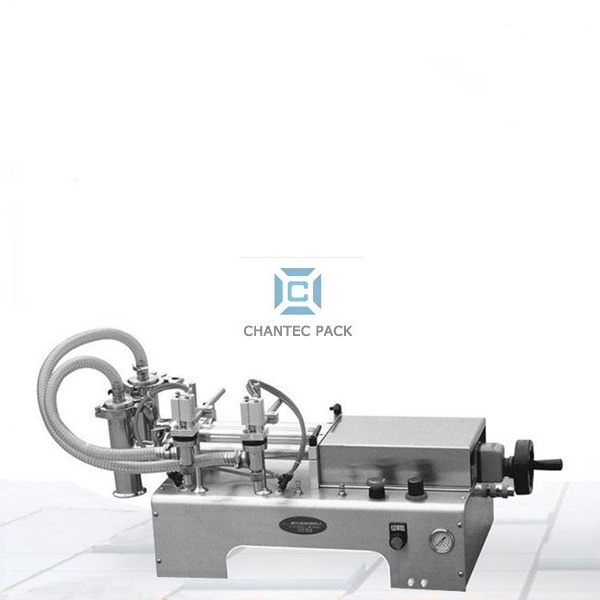
PISTON FILLER-liquid pump
Category: Auxiliary equipment
For filling liquids, pastes kinds.<br/> By piston driven cylinder to control volume.<br/> Semiautomatic feeding liquid with pedal switch or automatic timer; also can be synchronized with other automatic packing machine as dosing unit for different liquid.
Product Detail
For filling liquids, pastes kinds.
By piston driven cylinder to control volume.
Standard filling size:
Capacity:35L
Filling Range:20-500g
Error: ≤±1%
A Piston Filler-Liquid Pump is a precision volumetric metering device engineered for accurate, repeatable filling of viscous to semi-viscous liquid products into containers, bags, or sachets. It combines the core mechanism of a piston-driven displacement pump with a user-friendly control system, making it ideal for industries that require strict dosage consistency—such as food and beverage (mayonnaise, ketchup, peanut butter), cosmetics (lotion, cream, shampoo), pharmaceuticals (liquid medicines, ointments), and household chemicals (detergent, fabric softener). Unlike gravity-fed or peristaltic pumps, this device excels at handling high-viscosity fluids that are prone to splashing or air entrapment during transfer.
Core Working Principle & Operational Workflow
The piston filler-liquid pump operates on the principle of positive displacement, where a precisely sized piston draws a fixed volume of liquid from a reservoir and expels it into the target container. The workflow is a cyclic, automated process optimized for accuracy:
- Liquid Intake (Suction Stroke)The pump is connected to a bulk liquid reservoir via an inlet valve. When the piston retracts backward within its cylinder, it creates a vacuum that opens the inlet valve and draws liquid into the cylinder chamber. The volume of liquid intake is determined by the piston’s stroke length— a fixed parameter that can be adjusted manually or via a servo motor for different fill volumes.
- Valve Switching & Chamber IsolationOnce the piston reaches the end of its suction stroke, the inlet valve closes automatically, sealing the fixed volume of liquid inside the cylinder. Simultaneously, the outlet valve opens in preparation for discharge, preventing backflow of liquid into the reservoir and ensuring no additional material enters the chamber.
- Liquid Discharge (Discharge Stroke)A motor-driven mechanism pushes the piston forward, applying steady pressure to the liquid inside the cylinder. This pressure forces the liquid through the open outlet valve and into the filling nozzle, which is positioned directly above or inside the target container. For high-viscosity materials, the piston’s forward speed is controlled to prevent splashing and ensure smooth, uniform filling without air bubbles.
- Cycle Completion & ResetAfter the piston fully extends and expels the entire volume of liquid, the outlet valve closes, and the inlet valve reopens. The piston retracts again to start a new suction stroke, creating a continuous, cyclic filling process that matches the speed of downstream packaging equipment.
Key Components
- Piston & Cylinder Assembly: The core metering unit, typically made of food-grade 316 stainless steel (for corrosion resistance and hygiene) or PTFE-lined materials (for sticky, abrasive liquids). The piston’s diameter and stroke length dictate the maximum fill volume, with customizable sizes for small-dose sachets (1–50 mL) to large containers (1–10 L).
- Inlet/Outlet Valves: Spring-loaded or pneumatically operated valves that control liquid flow direction. They are designed to seal tightly to prevent cross-contamination and ensure no volume loss during transfer.
- Drive System: A servo motor or pneumatic actuator that controls piston movement with high precision. Servo-driven systems offer adjustable stroke lengths for quick product changeovers, while pneumatic systems are cost-effective for fixed-volume applications.
- Filling Nozzle: A retractable or fixed nozzle that directs liquid into containers. Retractable nozzles extend deep into containers during filling to minimize splashing and drippage, then retract before container removal to avoid contamination of sealing edges.
- Control Panel: A PLC or touchscreen interface that allows operators to set fill volumes, adjust piston speed, and store recipes for multiple products. Advanced models integrate with checkweighers for real-time accuracy calibration.
- Liquid Reservoir & Feed System: A hopper or tank that supplies liquid to the pump, often equipped with an agitator to prevent settling of suspended solids (e.g., fruit particles in jam) and a level sensor to alert operators when liquid levels are low.
Key Features & Advantages
- Exceptional Filling Accuracy & ConsistencyPositive displacement metering ensures fill volume accuracy within ±0.5%–1%, even for high-viscosity liquids. This precision is critical for compliance with regulatory standards in the pharmaceutical and food industries, where underfilling or overfilling can lead to product recalls.
- Versatile Compatibility with Viscous LiquidsUnlike centrifugal pumps that struggle with thick fluids, this piston-driven system handles a wide range of liquid viscosities—from semi-thin syrups to heavy pastes like peanut butter and body butter. It can also process liquids with suspended particles (e.g., salad dressing with herbs) without clogging.
- Quick Product Changeovers & Recipe StorageServo-driven models allow one-touch adjustment of piston stroke length to switch between fill volumes, eliminating the need for manual part replacements. The control panel can store dozens of recipes, reducing downtime for multi-product production lines.
- Hygienic & Easy-to-Clean DesignAll liquid-contact parts are made of 316 stainless steel, compliant with FDA, EU 10/2011, and GMP standards. The assembly features quick-disconnect fittings for CIP (Clean-in-Place) or SIP (Sterilize-in-Place) cleaning, preventing cross-contamination between batches.
- Low Drippage & SplashingRetractable filling nozzles and controlled piston speed minimize product waste and container contamination. The sealed valve system also prevents post-filling drips, ensuring clean, neat packaging.
Typical Application Scenarios
Piston filler-liquid pumps are a staple in industries requiring precise viscous liquid filling:
- Food & Beverage: Filling mayonnaise, ketchup, peanut butter, jam, honey, and salad dressing into jars, bottles, or pouches.
- Cosmetics & Personal Care: Dispensing lotion, cream, shampoo, conditioner, and body butter into tubes, bottles, or sample sachets.
- Pharmaceuticals: Metering liquid medicines, ointments, and topical creams into vials, tubes, or blister packs.
- Household Chemicals: Packaging liquid detergent, fabric softener, and dish soap into bottles or refill pouches.
Keywords:
Download attachmen:
Relative Products

Follow us on social media


Copyright: Hefei IECO Intelligent Equipment CO.,LTD
 sales@chantecpack.com
 Message

Contact with us
 Hotline: +86-0551-68899421
 Phone: +86 13731992050
 Email: sales@chantecpack.com
 whatsapp/wechat: +86 13731992050
 FACTORY ADD:2# workshop, no.200 chaoyang road,gangji town,changfeng county ,hefei,china
OFFICE:3# workshop 1st floor Changning Ave.High-tech district,Hefei,China
