
Products
Product Detail
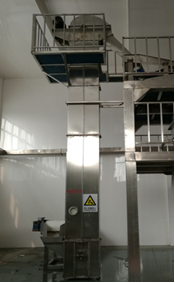
A Bucket Elevator is a robust, vertical material-handling machine designed to transport bulk solid materials—such as grains, ores, coal, cement, sugar, and fertilizer pellets—between different elevation levels in industrial facilities. It consists of a series of attached buckets fixed to a rotating belt or chain, which scoops up material at the lower inlet and discharges it at the upper outlet. Widely used in agriculture, mining, construction, food processing, and chemical industries, bucket elevators offer a space-saving, high-efficiency solution for vertical material transfer, even for heavy or abrasive loads.
Core Working Principle & Operational Workflow
The operation of a bucket elevator follows a simple, cyclic process optimized for continuous vertical transport:
- Material Loading (Lower Section)The elevator’s lower end (boot section) is positioned at the source of the bulk material. As the belt or chain rotates, the buckets pass through the boot and scoop up material from the hopper or storage pile. There are two primary loading methods, chosen based on material flowability:
- Direct Loading (Digging Method): Suitable for free-flowing materials (e.g., grains, sand, sugar crystals). Buckets dig directly into the material pile in the boot, filling themselves as they rotate upward.
- Indirect Loading (Feeding Method): Used for abrasive, heavy, or non-free-flowing materials (e.g., ore, cement clinker). A separate feeder (e.g., screw feeder, vibratory feeder) delivers material directly into the buckets to avoid excessive wear on the bucket edges.
- Vertical ConveyingThe rotating belt or chain carries the filled buckets upward along a rigid frame (enclosed in a casing to prevent material spillage and dust emission). The frame is equipped with guide rails and pulleys/sprockets to ensure stable, smooth movement of the bucket assembly. The conveying speed is adjustable via a variable-frequency drive (VFD) to match different material types and throughput requirements.
- Material Discharging (Upper Section)When the buckets reach the upper end (head section) of the elevator, they pass around a drive pulley or sprocket. The centrifugal force generated by the rotation flings the material out of the buckets and into a discharge chute, which directs the material to the target storage bin, processing machine, or conveyor line. The discharge trajectory is calibrated based on bucket size and conveyor speed to ensure complete emptying of the buckets.
- Return CycleAfter discharging, the empty buckets rotate back down the elevator’s return side to the boot section, completing the cycle and preparing for the next round of loading.
Key Components
- Buckets: The primary material-carrying components, typically made of steel (for heavy/abrasive materials), plastic (for food-grade or lightweight materials), or rubber (for impact-resistant applications). Bucket shapes vary—common types include deep buckets (for free-flowing materials) and shallow buckets (for sticky or lumpy materials).
- Belt/Chain: The drive mechanism that holds the buckets. Rubber belts are used for lightweight, non-abrasive materials (e.g., grains, sugar), while heavy-duty chains are preferred for abrasive, high-load applications (e.g., mining, construction).
- Boot Section: The lower part of the elevator, housing the tail pulley/sprocket, tensioning device, and material loading hopper. The tensioning system keeps the belt/chain tight to prevent slippage.
- Head Section: The upper part, containing the drive pulley/sprocket, motor, gearbox, and discharge chute. The drive system provides the power to rotate the bucket assembly.
- Casing/Frame: A rigid, enclosed structure that supports the elevator components and prevents material spillage and dust leakage. It is usually made of steel panels, with access doors for maintenance and cleaning.
- Drive System: Comprises an electric motor, gearbox, and VFD (optional) to control the conveyor speed. Explosion-proof motors are available for hazardous environments (e.g., chemical plants, grain silos).
Key Features & Advantages
- High Vertical Transport EfficiencyBucket elevators have a small horizontal footprint while delivering high throughput—capacities range from a few cubic meters per hour to over 1,000 cubic meters per hour, depending on the model. This makes them ideal for facilities with limited floor space.
- Versatile Material CompatibilityThey can handle a wide range of bulk materials, including free-flowing granules (grains, sugar), abrasive solids (ore, cement), sticky lumps (fertilizer, wet coal), and even fragile materials (potato chips, cereal) with gentle handling designs.
- Low Energy ConsumptionCompared to alternative vertical transport methods (e.g., pneumatic conveyors), bucket elevators consume less energy per ton of material transported, reducing operational costs for long-term use.
- Durable & Low-Maintenance DesignThe robust steel frame and wear-resistant components (e.g., chain, steel buckets) are built for continuous 24/7 operation in harsh industrial environments. Routine maintenance only involves checking belt tension, lubricating bearings, and inspecting bucket integrity.
- Dust-Free & Safe OperationThe enclosed casing prevents material spillage and dust emission, improving workplace safety and complying with environmental regulations. For flammable materials (e.g., grain dust), the elevator can be equipped with dust collection systems and explosion vents.
Typical Application Scenarios
Bucket elevators are essential in a wide range of industrial settings:
- Agriculture: Transporting grains (wheat, corn, rice), seeds, and animal feed between silos, dryers, and packaging lines.
- Food Processing: Conveying sugar, flour, cereal, and snack pellets in mills, bakeries, and confectionery factories.
- Mining & Construction: Moving ore, gravel, sand, and cement clinker in quarries, cement plants, and construction sites.
- Chemical & Fertilizer Industry: Handling fertilizer pellets, chemical powders, and industrial granules in production and storage facilities.
Keywords:
Download attachmen:
Relative Products

Follow us on social media


Copyright: Hefei IECO Intelligent Equipment CO.,LTD
 sales@chantecpack.com
 Message

Contact with us
 Hotline: +86-0551-68899421
 Phone: +86 13731992050
 Email: sales@chantecpack.com
 whatsapp/wechat: +86 13731992050
 FACTORY ADD:2# workshop, no.200 chaoyang road,gangji town,changfeng county ,hefei,china
OFFICE:3# workshop 1st floor Changning Ave.High-tech district,Hefei,China
